Ⅲ. Advantages of GI-180 Lining System
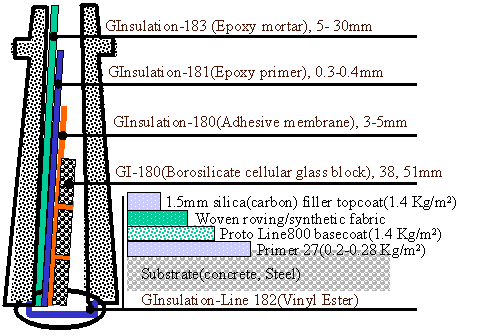
GI-180 lining system is comprised of glass block (GI-180), Adhesive/Membrane (GInsulation-180), Epoxy Primer (GInsulation-181), repair material (GInsulation-183) and Waterproof flooring material (GInsulation-Line182). Glass blocks prevent substrates from corrosive gases and liquids while primer & membrane works as bonding material of glass blocks to substrates as well as protection material of substrates. Repair material is for repairing damaged parts while waterproof flooring material protects floor from chemical concentrates.
* Substrate ; may be carbon steel, metal alloy, ceramic brick, concrete.
* GI-180 Borosilicate cellular glass block ; Being of closed cellular structure, the foamed borosilicate glass does not allow penetration of acid gas, water or acid condensates even under positive pressure conditions. GI-180 Borosilicate cellular glass block handles most of the flue gas conditions in stacks, ductwork, and other parts of FGD equipment,
* GInsulation-180 Adhesive Membrane is a 2 component urethane asphalt mastic
GInsulation-180 Adhesive Membrane is the only material used for installation of the GI-180 Borosilicate cellular glass block.
GInsulation-180 Adhesive Membrane is also used as a bond breaker between the GI-180 block and other materials.
On the substrate, the GInsulation-180 Adhesive Membrane remains elastomeric, being effectively insulated from high temperature and aggressive gas. After being in service in various flue gas environments for almost 20 years, the GI-180 cellular glass block lining system still functions satisfactorily and the urethane asphalt mastic is still elastomeric.
* GInsulation-181 Epoxy Primer is desined for carbon steel, stainless steels and other substrates.
1. Anti-Corrosion
GI-180
borosilicate cellular glass is made of raw glass with
B2O3-included
glass, which has excellent chemical-proof and
heat-proof properties by the strong chemical bonding to be
used for acid-proof containers such as beakers and dishes.
Since block uses this good quality glass with excellent
acid-proof and heat-proof material, it will provide the same
properties when it is formed into the foam glass. GI-180
block has impermeability that does not allow sulfurous
acid air pollutants to penetrate and leaves no corrosion.
The block itself is made of inorganic borosilicate without
any adhesives and has excellent endurance to almost every
acidic substance/solvent/weak alkali substance except for
HF. In addition, this closed porous structure does not
show the capillary phenomenon. Only the surface gets wet not
allowing the solution to be absorbed.
GInsulation-180(Adhesive/Membrane) is
urethane asphalt mastic material and adheres the blocks
which are constructed on the fundamental structure and
blocks to perform corrosion-proof ability to various acidic
substances/ alkali substances and salt
solutions.
2. Superb resistance against thermal shock
Each block is adhered to the other blocks by elastic epoxy bonding material by GI-180 lining system. And glass block has very low thermal transformation rate, the system can stand drastic thermal shocks. This can be explained by two major factors : The first one is that glass blocks of GI-180 lining system have very low thermal expansion rate, 55× 10-7/℃, which are not broken or cracked even by bigger changes in ambient temperature. With this outstanding feature, the system is very reliable and stable in operation. The second factor is superb elasticity of epoxy bonding material which adheres blocks to primer (GInsulation-181) on substrate structure. Epoxy bonding material (GInsulation-180) has capability to absorb thermal shock with keeping elasticity, which can absorb possible thermal expansion in between blocks and heat as well.
Glass blocks made of borosilicate glass are heat resistant to temperature approx. 500℃. And when they are used as lining material, block's surface temperature must not exceed 450℃. If it exceeds over 450℃, fire proof bricks should be adhered in front of glass blocks. Epoxy bonding material and membrane have lower thermal resistance, they should not be exposed over 110℃ directly or indirectly. For instance, under the condition of exhaust gas speed, 10 miles/hour with 50 mm thickness glass block lining, 177℃ gas temperature affects 38℃ on epoxy bonding material and membrane. Even though thermal resistance of epoxy bonding material and membrane is 110℃, they are applicable to hotter areas with superbly low thermal insulation rate of cellular glass blocks.
A major advantage of the GI-180 lining system is its ability to handle radical temperature swings without affect to the lining system or the underlying structure.
There are two major reasons for this :
First, The glass blocks themselves have extremely low coefficient of thermal expansion :
GI-180 borosilicate cellular glass block : 55× 10-7/℃,
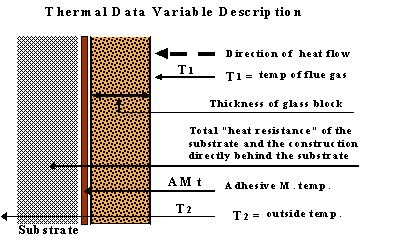
Second, The GInsulation-180 Adhesive Membrane(Ad/M) remains elastomeric, as long as the temperature of the Ad/M at the substrate remains under 93 ℃. The joints around the glass blocks function as "built-in"expansion joints. The temperature of the Ad/M at the substrate depend upon:
- The temperature of the flue gas.
- The thickness of the glass block.
- The "heat resistance" of the protected substrate itself.
- The "heat resistance" of any other construction that may be behind the protected substrate.
- The outside temperature.
It is not difficult to understand that the temperature of the Ad/M depends upon the flue gas temperature and the outside temperature. If one of these rises, the temperature of the membrane will become higher. Thicker glass blocks offer more "heat resistance" and a relatively lower temperature of the membrane at the substrate is expected. To understand the effect on the "Adhesive Membrane temperature"(AMt) consider the following:
If the total "heat resistance" of the substrate itself and the construction behind the substrate is infinite, the AMt will become equil to the flue gas, no matter how good or thick the installation between the flue gas the membrane is. If the "heat resistance" is zero, the AMt will remain equal to the outside temperature.
For so called "stationary" situations it is not difficult to calculate a temperature profile. However, when the temperature of the gas rises, it will take some time before this higher temperature has any effect on the temperature of the membrane.
In this guide, example calculations of temperature profiles have been inserted, each for typical construction that can found in flue gas ducts or chimneys.
The calculation that follow are summarized here. The calculation are for stationary situations.
|
Construction consists of : (from the "hot" side to the "cold" side | Flue gas temp. T1 |
Out side temp. T2 |
Ad/M temp. AMt | Remarks: |
1 |
- 51mm GI-180 block - Ad/M - 6 mm thick steel |
130℃ |
10℃ |
20℃ |
This situation may occur in a steel duct for unscrubbed flue gas |
2 |
- 38mm GI-180 block - Ad/M - 300mm of concrete |
130℃ |
10℃ |
45℃ |
Concrete insulates "better"than steel which results in a higher temp. of the Ad/M |
3 |
- 38mm GI-180 block - Ad/M - 360mm of concrete - 2000mm annular space - 450mm of concrete |
130℃ |
10℃ |
78℃ |
The influence of an annular space may be difficult to establish. If a draft occers through the annular space, it will insulate less strongly. |
4 |
- 38mm GI-180 block - Ad/M - 20mm thick steel - 1800mm annular space - 200mm of concrete |
130℃ |
10℃ |
51℃ |
Example for a GI-180 lining system in a steel flue in a reinforced concrete chimney |
3. Thermal insulation capability
GI-180 Lining System increases speed of exhaust flue gas by maintaining exhaust gas temperature with its excellent thermal insulation capability. It is better to exhaust flue gas as much as possible and as fast as possible. But generally speaking, exhaust gases through desulfurization facility, gas temperature lowered and this hampers and delays gas exhaust speed slower. With GI-180 lining system having superb thermal insulation capability, exhaust gas temperature is kept at relatively higher state to be exhausted efficiently without making chemical concentrates, which are very much corrosive to gas exhaust system. Glass blocks has outstanding thermal insulation capability, more than 10 times of same thickness acid resistant bricks and more than 5 times of same thickness of the other lining system. In this connection, there is no need to implement additional exterior thermal insulation works, which brings much cost saving with GI-180 lining system. Another important advantage is that GI-180 lining system protects substrate structure of carbon steel or concrete or fire proof bricks from thermal expansion shock with its excellent thermal insulation property. Without thermal insulation lining material, the structure may get excessive heat from high temperature exhaust flue gases to dangerous level, which damages the structure severely. Repeated influences on the substrate structure would damage exhaust system, which must shorten service life time of the structure. In this respect, it is appropriate way to implement GI-180 lining system to have longer service life time at more competitive cost.
4. Simple Construction
Hard ashes would be eliminated by sand blasting on the existing liners of chimney. After cleansing primer coating on the surface, adhesive membrane is additionally coated on it. Then borosilicate cellular glass blocks are attached to the coated membrane. With such relatively simple work, condensed water or moisture-rich exhaust gas produced inside would not come in contact with brick liner or castable liner.
5.
Lightweight characteristic
The density
of light weight block is approximately 0.19
g/cm3±10%.
Therefore, thickness of 50mm is a mere weight of
9.5Kg per square meter. This light weight
allows various flexibility in the duct and stack
design. And it also can be additionally constructed on
special places where heavy linings cannot be used. In
addition, it saves lots of cost from the fundamental
structure.
6. Comparison to other lining products
Lining
material which takes care of various exhaust gases uses
metal materials. Generally, sheet metal(1/16“ thick) or
1/4” thick metal plate cost a lot considering the basic
costs for metal and construction. In addition, skillful
welders are needed and additional quality control requires
cost. For ally plates, additional single construction cost
of outside should be included. Though prices of various
related products are changing moment by moment, the metal
linings(317, C-276, C-22, titanium) are quite expensive
compared to the glass block lining system..
Some metal lining suppliers claims that
metal lining does not need any maintenance with 30 years
of usage term after construction, but it is just a guess
because assumption from the simple experiment at a
laboratory cannot tell the whole story of 30 years of long
term, especially in the construction industry. Practically,
the corrosion-related materials should follow the
requirements for maintenance. The maintenance data for
alloy lining shows the construction cost only is too high
to consider. Though the metal lining supplier is right, the
glass block system has higher investment effect only in
the cost-effectiveness.
Organic
material coating construction is sometimes performed in FGD
duct work or stack lining construction, which has
relatively lower initial cost such as cost for materials
and construction compared to that of construction of glass
blocks and coating materials. Some coated construction
sites are not exposed to extreme circumstances in system
operation and easy coating work can save cost leaving a
worry of using of the organic material under severe
circumstances of FGD. The organic material coating also
has the same purpose of standing high temperature and
mechanical stress and preventing corrosion by inhibiting the
penetration of chemicals.
The features
of glass blocks and the related materials are reliable.
Glass block lining system can be maintained firmly by
long-term proved reliability, adequate initial investment,
low maintenance cost. This method provides cost reduction
to the metal liner users and, more reliable system to the
existing coating
users.
◎ Comparison to other rival products
| - | Organic Coatings (epoxy vinyl ester) | Acid-Resistant Gunite Materials | Metal Alloy Materials | GI-180(Borosilicate Glass Brick Linings of ECO CERA Co.,Ltd.) |
| Advantages |
ㆍExcellent
chemical endurance |
ㆍResistant
to strong acid ㆍEconomic installation
|
ㆍExcellent chemical endurance |
ㆍExcellent
chemical endurance (Chlorides, condensates of
sulfuric acid) |
| Disadvantages |
ㆍPermeability
of acidic precipitates |
ㆍCracks of
Lining |
ㆍHigh
initial cost |
ㆍSusceptible to physical conflicts |
◎Maintenance cost of stack (Including installation and repair cost for 20 years; US standard)
| - | Organic Coating | Gunite | Metal Alloy | GI-180 |
| Initial cost | Low | Normal | High | Below Normal |
| Long-term maintenance Cost | High | Normal/High | Low/Normal | Low |
| Service life | Short-term | Short-term/Normal | Normal/Long-term | Long-term |